
After Nearly 30 Years, the U.S. Has a New Sunscreen Filter
For decades, sunscreen innovation in the United States has lagged behind much of the rest of the world. While Europe, Australia, Japan, and South Korea have had access to newer generations of highly effective UV filters, American formulators have largely relied on the same collection of active ingredients approved decades ago.
That finally changed on June 9, 2026, when the U.S. Food and Drug Administration (FDA) finalized an order adding bemotrizinol (BEMT) to the U.S. OTC sunscreen monograph. This made BEMT the first new sunscreen active ingredient added to the U.S. monograph since the late 1990s – and the first major addition to the U.S. sunscreen toolbox in nearly three decades.
Although new to the U.S. market, BEMT is hardly a new ingredient. It has been used internationally for more than twenty years and has earned a reputation as one of the most effective and versatile organic UV filters available.
So what makes this ingredient so interesting? Let’s take a closer look.
What Is Bemotrizinol?
INCI/USAN: Bemotrizinol
Common chemical name: Bis-Ethylhexyloxyphenol Methoxyphenyl Triazine
Abbreviation: BEMT
CAS: 187393-00-6
Molecular formula: C₃₈H₄₉N₃O₅
Molecular weight: 627.81 g/mol
Chemical Structure:
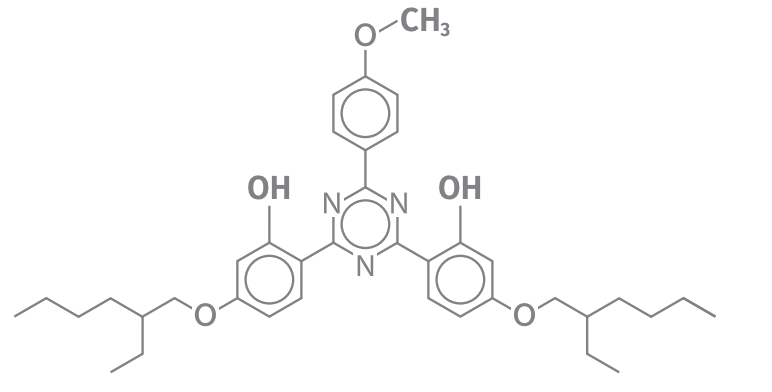
Bemotrizinol (BEMT) is a lipophilic, oil-soluble organic UV filter that provides broad-spectrum protection across both the UVA and UVB regions of the ultraviolet spectrum.
What makes BEMT particularly interesting is that it combines broad UV absorption, exceptional photostability, high extinction efficiency, and low skin penetration in a single filter. These properties have made it one of the most widely used modern organic sunscreen filters outside the United States – and now an important new option for U.S. formulators.
Unlike many older sunscreen filters that are primarily concentrated in either the UVA or UVB portion of the spectrum, BEMT has a broad absorption profile spanning both regions. This allows it to serve as a highly efficient broad-spectrum building block in modern sunscreen formulations.
How Does BEMT Protect the Skin?
Like other organic (commonly called “chemical”) sunscreen filters, BEMT works by absorbing ultraviolet radiation before it can damage skin cells.
When UV light strikes a BEMT molecule, the molecule temporarily enters a higher-energy state. Instead of allowing that energy to damage DNA or generate harmful free radicals within the skin, BEMT rapidly converts the absorbed UV energy into small amounts of harmless heat before returning to its original state.
This process happens continuously every time the sunscreen is exposed to sunlight. The result is reduced UV-induced damage while maintaining excellent cosmetic elegance.
Why Cosmetic Chemists Love BEMT
Not all UV filters are created equal. From a formulator’s perspective, the ideal sunscreen active needs to do more than simply absorb UV radiation. It should be photostable, efficient at relatively low concentrations, compatible with other filters, provide broad spectral coverage, and remain where it is applied.
BEMT checks many of those boxes.
1. Exceptional Photostability
One of BEMT’s most important formulation advantages is its exceptional photostability.
Some organic UV filters, most notably avobenzone, can undergo photochemical degradation after prolonged exposure to UV radiation. As the filter degrades, its concentration and UV-absorbing performance can decrease, potentially compromising the overall stability of the sunscreen system.
BEMT, by contrast, is highly resistant to photodegradation. Its molecular structure allows it to absorb UV energy while dissipating that energy efficiently without undergoing significant chemical breakdown.
This makes BEMT particularly valuable in formulations where long-lasting UV protection and filter stability are priorities.
2. It Stabilizes Other UV Filters
BEMT’s benefits extend beyond its own exceptional photostability. It can also contribute to the stabilization of other UV filters, most notably avobenzone.
Avobenzone is one of the most important UVA filters available to U.S. formulators, but its relatively poor photostability has historically required formulators to build stabilization strategies around it, often using ingredients such as octocrylene. However, growing regulatory scrutiny surrounding octocrylene – particularly in the EU – may increasingly limit this approach, creating a need for alternative ways to improve avobenzone stability.
This is where BEMT can offer an additional formulation tool. When combined with avobenzone and other UV filters, BEMT can help improve the photostability of the overall filter system, potentially reducing reliance on any single photostabilization strategy.
For formulators, this flexibility can be especially valuable when developing sunscreen systems in which filter stability, regulatory considerations, and sensory performance all need to be balanced.
3. Broad-Spectrum Protection from a Single Filter
Many sunscreen formulations require several UV filters working together because individual filters typically absorb only portions of the UV spectrum. Historically, this has been particularly challenging around the transition from UVB to UVA at approximately 320 nm.
The region from 320–340 nm is generally classified as UVA-II, and the traditional U.S. sunscreen filter palette has offered relatively limited options for achieving strong, efficient, and photostable absorption through this portion of the spectrum while also providing substantial coverage deeper into UVA-I.
This is sometimes informally described as the “320 nm gap.” The term does not mean that conventional U.S. sunscreens provide zero protection at 320 nm. Rather, it describes a historical limitation in the available filter toolkit: achieving strong, continuous coverage across the UVB-to-UVA transition could require combining multiple filters.
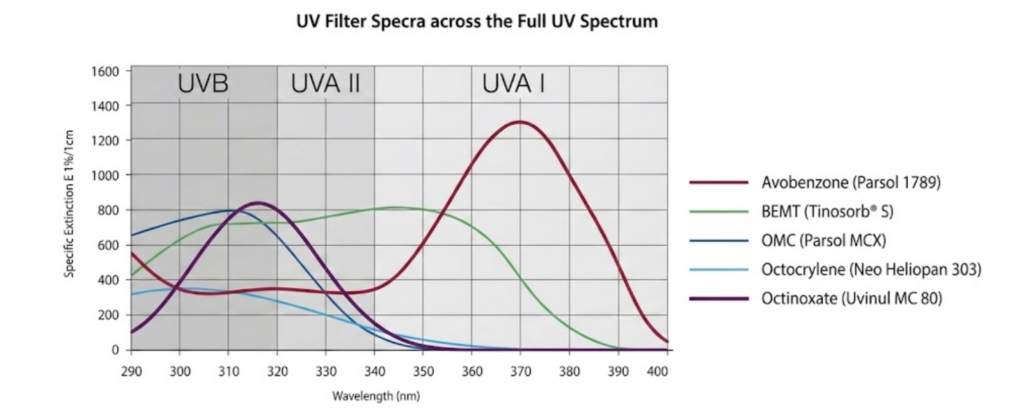
BEMT helps address this challenge. As shown in the absorption spectrum above, BEMT exhibits two major absorption maxima at approximately 310 nm and 340–345 nm, while maintaining substantial absorption across the wavelengths between and around these peaks. This gives BEMT meaningful coverage spanning UVB and UVA, including the important transition region around 320 nm.
For comparison:
- Octinoxate is primarily a UVB filter.
- Avobenzone provides strong UVA absorption, particularly into UVA-I.
- Octocrylene contributes primarily to UVB absorption.
- BEMT provides substantial absorption across a much broader portion of the UV spectrum from a single organic filter.
This doesn’t mean a sunscreen needs only BEMT. Rather, BEMT gives formulators a highly efficient broad-spectrum building block that can be combined with other filters to optimize SPF, UVA protection, photostability, sensory properties, and regulatory requirements.
4. High Extinction Efficiency
BEMT isn’t simply broad-spectrum – it is also an efficient UV absorber.
Its high specific extinction means that BEMT can absorb a substantial amount of UV radiation relative to its concentration. For formulators, this is important because the goal isn’t simply to add more sunscreen active; it’s to achieve the desired UV performance while maintaining acceptable texture, aesthetics, solubility, stability, and overall formula cost.
BEMT’s combination of broad spectral coverage and high extinction efficiency makes it particularly useful when designing high-performance sunscreen systems.
5. Low Skin Penetration
Another important characteristic of BEMT is its low absorption through the skin. Its relatively large molecular size, high lipophilicity, and physicochemical characteristics make significant systemic absorption less likely.
While no sunscreen ingredient should be judged solely on absorption studies, this property has made BEMT particularly attractive as regulatory agencies continue evaluating sunscreen safety.
The FDA’s scientific review included dermal absorption studies of BEMT in different formulations. Based on the current evidence, the overwhelming majority of applied BEMT remains within the outer layers of the skin where UV protection is needed.
Is BEMT a “Chemical” Sunscreen?
Yes – but the terminology deserves clarification.
BEMT is classified as an organic UV filter. Despite the common consumer term “chemical sunscreen,” both mineral and organic sunscreen ingredients are chemicals in the scientific sense.
The difference lies in how they are classified:
- Organic UV filters are carbon-containing molecules that primarily absorb UV radiation.
- Mineral UV filters, such as zinc oxide and titanium dioxide, are inorganic particles that protect through a combination of absorption, scattering, and reflection of UV radiation.
Neither category is automatically better or worse. The performance of a sunscreen depends on the specific filters, concentrations, formulation, film properties, and how the finished product is used.
Is BEMT Better Than Zinc Oxide?
Not necessarily. BEMT and zinc oxide are fundamentally different UV-filter technologies.
Zinc oxide offers broad-spectrum protection and remains an important option for mineral sunscreen formulations. However, BEMT offers several potential advantages:
- No white cast
- Greater formulation flexibility
- Improved cosmetic elegance
However, the real advantage of BEMT isn’t that it “beats” zinc oxide, instead it gives formulators another tool. And in sunscreen formulation, having more tools matters.
The INCI Files Take
Few cosmetic ingredients have generated as much excitement among formulation scientists as Bemotrizinol.
The FDA approval of Bemotrizinol represents more than the introduction of a single ingredient. It marks the first meaningful expansion of the U.S. sunscreen ingredient toolbox in decades.
Will BEMT replace every existing sunscreen active? Certainly not. But it has the potential to become an important building block in the next generation of U.S. sunscreen formulations.
And as additional next-generation UV filters eventually make their way into the U.S. market, the possibilities for higher-performing, more stable, and more cosmetically elegant sunscreens will only expand.
BEMT isn’t the end of the story. It’s the beginning of a new chapter for U.S. sunscreen formulation.
Formulator Notes
BEMT is a highly photostable, broad-spectrum UVA/UVB filter. However, its high molecular weight (~627 g/mol) and crystalline, oil-soluble nature make solubilization, oil-phase composition, and crystallization control key formulation considerations.
Supply
In the U.S., BEMT is commercially associated with dsm-firmenich (PARSOL® Shield) and BASF (Tinosorb® S). For the U.S. OTC sunscreen market, DSM’s FDA submission requested 18 months of market exclusivity for BEMT; the status and scope of any exclusivity should be verified at the time of use.
Incorporation & Processing
- Incorporate BEMT into the oil phase with an appropriate solvent/emollient system.
- Heat to approximately 75–80°C (167–176°F) and mix until fully dissolved and the phase is clear.
- Insufficient solubilization can lead to recrystallization during cooling or storage, potentially affecting product uniformity and UV performance.
Solubility
BEMT has limited solubility in many cosmetic oils, so solvent selection and total solvent capacity are critical. The following values can be used as approximate formulation guides rather than universal solubility limits:
| Solubilizer | BEMT Solubility at 25°C |
| PARSOL EHS | ~20% |
| PARSOL MCX | ~17% |
| PARSOL HMS | ~16% |
| Isodecyl Salicylate | ~18% |
| C12-15 Alkyl Benzoate | ~14% |
| Dibutyl Adipate | ~10% |
Values are approximate saturation levels and may vary with temperature, raw-material grade, solvent purity, and the overall oil-phase composition. Always confirm solubility and crystallization behavior in the final formulation.
Sensory Optimization
Higher BEMT concentrations can increase the richness or tack of a formulation, particularly when higher levels of polar solvents are required for solubilization. Lightweight emollients such as C9-12 Alkanes, Isododecane, and Isoamyl Laurate can help offset this effect and improve spreadability and after-feel.
Stability
Because recrystallization is one of the primary formulation challenges with BEMT, physical stability should be evaluated throughout development.
- Conduct freeze/thaw (F/T) and heat stability testing to assess crystallization and phase stability.
- Use polarized light microscopy to detect birefringent crystals that may not be apparent visually.
- If recrystallization occurs, increase solvent capacity, optimize the solvent blend, or redesign the oil phase.
- Evaluate stability after both processing and long-term storage, since a formulation that is initially clear may crystallize over time.
Regulatory Status
BEMT has been used extensively in markets outside the U.S., including Europe, Australia, and numerous Asian and South American markets. Permitted concentrations vary by jurisdiction; for example, the EU permits BEMT at concentrations up to 10%, while the U.S. OTC sunscreen monograph permits BEMT at 6%.
Because sunscreen regulations can change, always verify the current maximum permitted concentration and product-category requirements for the target market before commercialization.
References
- U.S. Food and Drug Administration. FDA Expands Sunscreen Options for the First Time in 20 Years. June 9, 2026.
- U.S. Food and Drug Administration. Final Administrative Order OTC000039 Amending OTC Monograph M020: Sunscreen Drug Products for Over-the-Counter Human Use. 2026.
- U.S. Food and Drug Administration. Scientific Review Supporting Proposed Administrative Order: Bemotrizinol. 2025.
- U.S. Food and Drug Administration. Clinical Overview / Physical and Chemical Characteristics of Bemotrizinol. 2026.
- U.S. Food and Drug Administration. ¹⁴C-BEMT in Different Cosmetic Formulations: Study of Penetration Through Human Skin In Vitro.
- PubChem. Bemotrizinol, CID 135487856. National Center for Biotechnology Information.
- BASF. Tinosorb® S Technical Information. Product technical information including solubility data at 25°C.
- BASF. Bemotrizinol / Tinosorb® S receives U.S. regulatory approval. June 12, 2026.
- Chatelain E, Gabard B. Photostabilization of avobenzone and ethylhexyl methoxycinnamate by bis-ethylhexyloxyphenol methoxyphenyl triazine. [Referenced in FDA scientific review and subsequent literature reviews.]
- Kawakami CM et al. Diethylamino hydroxybenzoyl hexyl benzoate as additive to the UV filter avobenzone in cosmetic sunscreen formulations. European Journal of Pharmaceutical Sciences. 2017.
- Wang SQ, Lim HW. Photoprotection: A Review of the Current and Future Technologies. Dermatologic Therapy. 2010.
- Hanson KM et al. Effects of solvent and micellar encapsulation on the photostability of avobenzone. Photochemical & Photobiological Sciences. 2020.