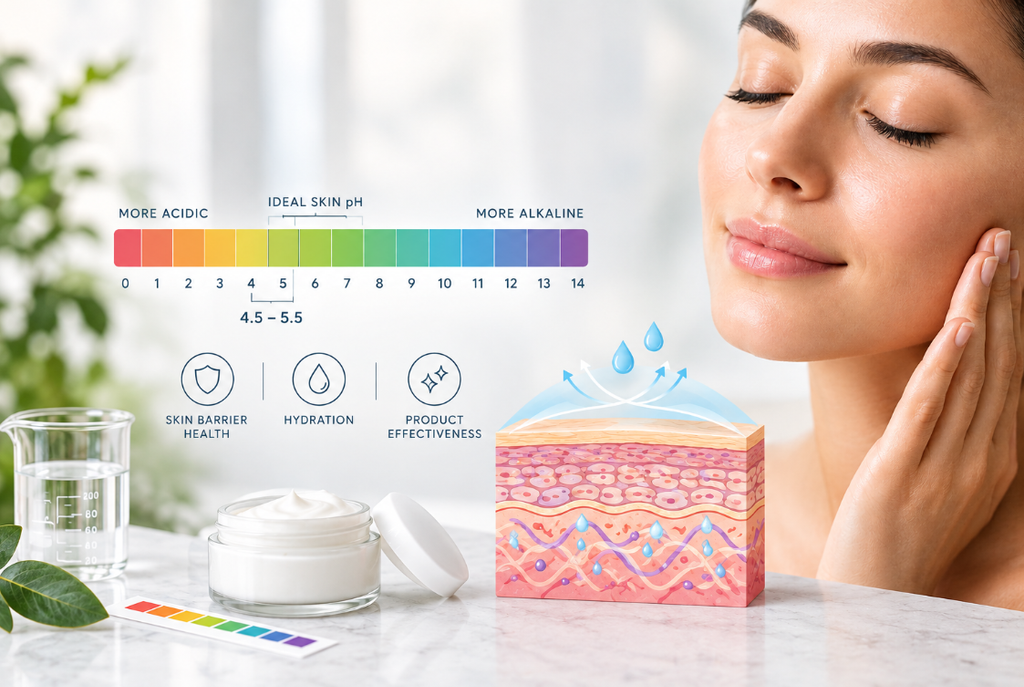
If you follow skincare, you’ve likely come across marketing claims such as “skin-neutral pH” or “pH-balanced.” But what do these terms actually mean, and how important is pH to your skin and skincare products?
pH plays a key role in both skin physiology and cosmetic formulation performance. It influences skin barrier function, enzyme activity in the stratum corneum, and the skin’s microbial environment. In cosmetic formulations, pH can also affect ingredient efficacy and stability, preservative efficacy, and overall product performance.
To understand why, we have to begin with some chemistry (nothing too complex, I promise).
What Is pH, and How Does It Work on the Skin?
pH measures hydrogen ion activity in a water-based system. Put simply, it tells you how acidic or alkaline a solution is.
The scale is logarithmic, so each one-unit change is roughly a 10-fold change in hydrogen ion concentration:
- pH 3 has about 10× more H⁺ than pH 4.
- pH 3 has about 100× more H⁺ than pH 5.
| pH | Classification |
| Below 7 | Acidic |
| 7 | Neutral (pure water at 25 °C) |
| Above 7 | Alkaline / basic |
Two points worth knowing:
- “Neutral” is not necessarily “ideal for skin.” Healthy skin is naturally acidic.
- pH is not the same as “how much acid is present.” A product can have a low pH with very little acid. Another can contain a lot of acid at a moderate pH. Which one you get depends on the acid’s pKa, how much of it has been neutralized, and the buffer system, if present.
Formulator’s note: pH is a property of a water-based phase, so anhydrous products such as oils, balms, and water-free silicone systems do not have a meaningful pH. In emulsions, direct pH measurement is generally appropriate when water is the continuous (external) phase, as in oil-in-water (O/W) systems. In water-in-oil (W/O) and water-in-silicone (W/Si) emulsions, the continuous phase is oil or silicone, making direct measurement unreliable.
pH vs. pKa vs. Free Acid
As described above, pH alone doesn’t tell us how much acid is actually present. For that, we also need the acid’s pKa. Put simply: pH measures how acidic a formula is, pKa measures how readily an acid ionizes, and free acid is the portion that stays non-ionized at the formula’s pH.
Rule of thumb:
| Formula pH relative to pKa | Free acid (HA) | Ionized (A⁻) |
| 1 unit below pKa | ~90% | ~10% |
| Equal to | ~50% | ~50% |
| 1 unit above | ~10% | ~90% |
Why free acid matters: the protonated form (HA) is less polar (more fat-soluble) than the ionized form (A⁻). That generally makes it more able to partition into the stratum corneum. But “more free acid” does not simply mean “better product.” Penetration and results could also depend on total concentration, the formula itself, buffering, contact time, and skin condition.
Let’s use glycolic acid (pKa ≈ 3.8) to demonstrate this a little further. Glycolic acid is an alpha-hydroxy acid (AHA) widely used in chemical exfoliants. It loosens the bonds that hold dead skin cells to the surface of the stratum corneum, revealing fresher, smoother skin underneath.
Consider two products that each contain 10% glycolic acid:
| Product | pH | Approx. free acid | Effective free glycolic acid |
| A | 3.8 | ~50% | ~5% |
| B | 4.8 | ~10% | ~1% |
Same label claim, roughly a fivefold difference in available free acid. So:
- Total acid concentration ≠ free acid concentration.
- Product pH ≠ acid concentration.
That’s why concentration, the acids’ pKa, and pH are always assessed together. The Cosmetic Ingredient Review (CIR) panel considered AHAs safe in consumer products at 10% or less and pH 3.5 or higher. The FDA recommends sun-protection labeling on AHA products because of their effect on sun sensitivity.
Formulation Note: When a formula needs to hold a specific pH range, a buffer system is often built in. A buffer is a weak acid paired with its conjugate base. A common example in cosmetics is citric acid and sodium citrate. Together, they resist pH shifts when small amounts of acid or base are introduced, whether from other ingredients, preservatives, or carbon dioxide absorbed from the air over time. Buffers have a limited capacity, however, and work best within about one pH unit of the acid’s pKa.
Why Is Skin Acidic? The Acid Mantle
The acid mantle is the thin, mildly acidic film on the surface of healthy skin. Reported pH values typically fall between 4 and 6, with many measurements clustering in the high 4s to low 5s. In one large multicenter study, natural skin surface pH averaged about 4.7 when participants avoided showering and cosmetics for 24 hours beforehand (Lambers et al., 2006).
Several factors contribute to skin’s acidity:
- Sweat
- Free Fatty acids from sebum and lipid processing
- Breakdown products of filaggrin
- Proton pumps in the epidermis
- Byproducts from resident microbes
What the acid mantle supports:
- Barrier integrity and processing of the barrier lipids
- Controlled shedding of dead skin cells (desquamation)
- Enzyme regulation
- A healthy microbiome and protection against certain pathogens
Skin pH is more than a surface reading. It acts as a biochemical regulator inside the stratum corneum (Brooks et al., 2025; Ali & Yosipovitch, 2013).
How Does pH Affect the Skin Barrier?
The stratum corneum is often compared to a brick wall:
- Corneocytes (flattened dead skin cells) are the bricks.
- Intercellular lipids (ceramides, cholesterol and free fatty acids) are the mortar.
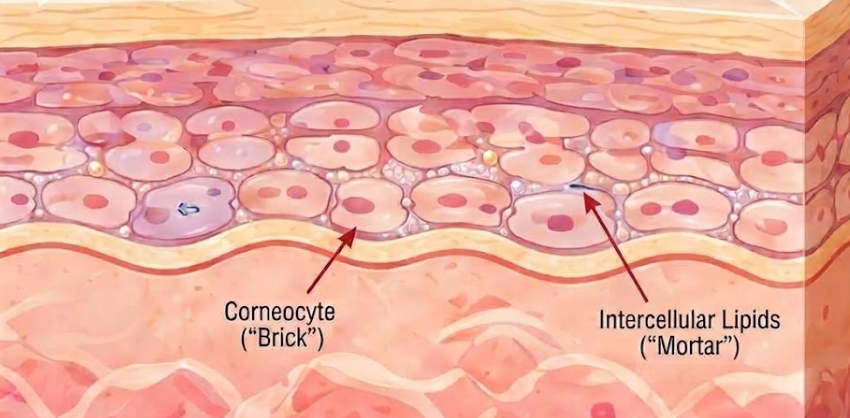
The enzymes that build and process these lipids, and the ones that control shedding, are pH-sensitive.
- Acidic conditions support ceramide production and an orderly lipid structure.
- More alkaline conditions speed up protein-degrading enzymes (serine proteases). These can break down cell-to-cell attachments too early and slow barrier repair (Wohlrab et al., 2018; Sakai & Hatano, 2025).
Can Soap, Cleansers, or Hard Water Change Your Skin’s pH?
Yes, temporarily. Skin can become more alkaline after contact with water, cleansers, and environmental factors. Traditional soap is the classic example. It’s made by reacting fats or oils with an alkali (saponification), so it is alkaline by nature, typically around pH 9–10.
What the research shows:
- Repeated alkaline exposure. Applying a pH 8.0 product over several weeks impaired barrier recovery and made skin more vulnerable to irritation from SLS, compared with acidic products (Kim et al., 2009).
- Water hardness (characterized by the amount of dissolved minerals present). Hard water can increase how much surfactant stays on the skin after washing. That residue is linked to higher skin pH and weaker barrier function (Danby et al., 2018).
Context matters: one wash with an alkaline cleanser will not permanently damage your skin. Skin has buffering capacity and drifts back toward its baseline. The real concern is repeated, sustained disruption, especially in skin whose barrier is already compromised, such as in atopic dermatitis.
Factors that determine how much a product shifts your skin’s pH:
| Factor | Why it matters |
| Product pH and buffering capacity | A strongly buffered product resists the skin’s own buffering |
| Amount applied and contact time | A few seconds is very different from hours |
| Rinse-off vs. leave-on | A cleanser is gone in under a minute; a serum stays on all day |
| Frequency of use | Repeated exposure adds up |
| Skin condition | A compromised barrier recovers more slowly |
Formulator’s note: Water hardness varies significantly by region, even within the same country. The USGS classifies water as soft (0-60 mg/L), moderately hard (61-120 mg/L), hard (121-180 mg/L), or very hard (over 180 mg/L), and U.S. supplies span all of these categories. When developing a product such as a cleanser for specific regions, test it in water that matches each target market. Calcium and magnesium ions can interact with surfactants and affect foam generation, lather quality, rinsability, and after-feel, so results from one region may not carry over to another. If a formula underperforms in hard water, chelating agents or a more hardness-tolerant surfactant system are common fixes to evaluate.
What pH Should Skincare Products Have?
If skin’s pH is acidic, should every product target an acidic range? Not necessarily. There’s no universal “correct” pH. The right target depends on what the product is meant to do and the chemistry it relies on.
| Product type | Typical pH* | Why |
| Traditional soap | ~9–10+ | Alkaline by nature because of saponification |
| Syndet cleanser | ~4.5–6.5 | Can be formulated close to skin pH |
| Moisturizer | ~4.5–6.5 | Skin compatibility, ingredient stability, preservation |
| Niacinamide product | ~5–7 | Niacinamide stability (it can break down to nicotinic acid at low pH) |
| L-ascorbic acid serum | ~2.5–3.5 | Keeps vitamin C mostly in its non-ionized form (pKa ≈ 4.2) |
| AHA/BHA product | ~3–4 | Controls how much free acid is available |
| Sunscreen | Depends on formula | Set by UV filter stability, emulsifier system, and preservatives |
*These ranges are general guidelines, not regulatory requirements. Commercial products can fall outside them.
pH is a design choice, not a scorecard. The right pH is the one that lets the whole formula perform safely, stably, and effectively.
Formulator’s note: Tear-free shampoos are often formulated near neutral pH (around 7) to more closely match the pH of tear fluid, which averages approximately 7.4. However, pH alone does not determine eye comfort. Mild surfactant selection and the overall formulation are equally important in minimizing stinging and irritation upon accidental eye contact.
Does “pH-Balanced” Mean Anything on a Label?
Not in a legally defined sense. “pH-balanced” and “skin-neutral pH” are marketing terms, and there is no regulatory standard for what they must mean. In practice, brands usually use them to suggest a product sits near skin’s natural pH range (about 4.5–6).
That can be a useful hint for everyday products like cleansers and moisturizers. But it isn’t a guarantee, and it isn’t always the goal. A vitamin C serum or an exfoliating acid is designed to be more acidic on purpose, and that doesn’t make it a bad product. If a brand lists its pH, great. If not, the claim alone tells you very little.
Skin pH and Common Skin Concerns
Skin pH is an active area of research in several common conditions. The findings are still evolving, and pH is only one piece of the picture, so treat this as background rather than treatment advice.
- Eczema / atopic dermatitis: skin surface pH tends to be higher in atopic skin, and the barrier recovers more slowly. Gentle, low-pH-friendly cleansers and moisturizers are commonly recommended.
- Acne: research on skin pH and acne is mixed. Harsh, highly alkaline cleansers can irritate, but there is no single pH that treats acne.
- Rosacea: the barrier is often sensitive and easily irritated, so gentle products and limiting harsh cleansers are usually advised.
If you have a diagnosed condition, a dermatologist can tell you what is right for your skin.
Can You Use Niacinamide With AHAs or Vitamin C?
This is one of the most common skincare pH questions. The concern comes from the fact that these ingredients work best at different pH ranges: niacinamide is stable at about pH 5–7, AHAs typically sit around pH 3–4, and L-ascorbic acid around pH 2.5–3.5. Formulated at the wrong pH, one ingredient can lose stability or the other can lose effectiveness.
In practice, well-formulated products can be used in the same routine, and many people do. If you notice stinging or redness, try using them at different times of day or on alternate days, and introduce one new active at a time.
How Formulators Use pH
For the people who make skincare products, pH is one of the strongest levers available:
- Ingredient stability: many actives, fragrances and botanicals only stay stable within a specific pH window.
- Preservative performance: weak-acid preservatives such as benzoic acid (pKa ≈ 4.2) and sorbic acid (pKa ≈ 4.8) work best in their protonated form. In practice, that generally means a formula below ~pH 5.5.
- Texture (rheology): carbomers and other acrylic polymers must be neutralized to build viscosity. Shifts in pH can thin or collapse a gel.
- Emulsion stability: pH affects emulsifier charge, polymer behavior, and interfacial properties.
- Compatibility: some ingredients don’t work well together at every pH. Niacinamide and AHA’s are a classic example. Formulated at the wrong pH, one ingredient can lose stability, or the other can lose effectiveness.
Formulator’s note: always measure pH at a set temperature and record it at each stability time point. pH drift is often one of the earliest signs of chemical or microbial instability.
The Takeaway
Healthy skin maintains an acidic environment that supports barrier lipids, enzyme activity, orderly shedding, and microbial balance. Products can shift that environment temporarily. How much depends on the product’s pH, its buffering capacity, contact time, frequency of use, and the condition of the skin.
With acids, keep three ideas separate:
- pH is the acidity of the formula.
- pKa is how a specific weak acid behaves (the pH at which it is half ionized).
- Free acid is the share of the acid that remains protonated and available.
So the next time a product boasts about having a “low pH,” skip asking “Is lower better?” Instead ask: “Why was this product formulated at this pH?” That’s where the real chemistry begins.
References & Further Reading
- Brooks SG, Mahmoud RH, Lin RR, Fluhr JW, Yosipovitch G. The Skin Acid Mantle: An Update on Skin pH. J Invest Dermatol. 2025;145(3):509–521.
- Ali SM, Yosipovitch G. Skin pH: From Basic Science to Basic Skin Care. Acta Derm Venereol. 2013;93(3):261–267.
- Schmid-Wendtner MH, Korting HC. The pH of the skin surface and its impact on the barrier function. Skin Pharmacol Physiol. 2006.
- Lambers H, Piessens S, Bloem A, Pronk H, Finkel P. Natural skin surface pH is on average below 5, which is beneficial for its resident flora. Int J Cosmet Sci. 2006.
- Wohlrab J, Gebert A, Neubert RH. Lipids in the Skin and pH. Curr Probl Dermatol. 2018;54:64–70.
- Sakai T, Hatano Y. Stratum corneum pH and ceramides: Key regulators and biomarkers of skin barrier function in atopic dermatitis. J Dermatol Sci. 2025;118(2):51–57.
- Kim E, et al. The alkaline pH-adapted skin barrier is disrupted severely by SLS-induced irritation. Int J Cosmet Sci. 2009;31(4):263–269.
- Tarun J, et al. Evaluation of pH of bathing soaps and shampoos for skin and hair care. Indian J Dermatol. 2014;59(5):442–444.
- Danby SG, et al. The Effect of Water Hardness on Surfactant Deposition after Washing and Subsequent Skin Irritation in Atopic Dermatitis Patients and Healthy Control Subjects. J Invest Dermatol. 2018;138(1):68–77.
- Schmid MH, Korting HC. The concept of the acid mantle of the skin: its relevance for the choice of skin cleansers. Dermatology. 1995;191(4):276–280.
- U.S. Food & Drug Administration. Alpha Hydroxy Acids. FDA Cosmetics.
- U.S. Food & Drug Administration. Guidance for Industry: Labeling for Cosmetics Containing Alpha Hydroxy Acids.
- U.S. Geological Survey. Hardness of Water: Water Hardness in the United States. Water Science School, U.S. Department of the Interior.